
When parents visit Momentum Athletic Performance for the first time, their first question is rarely about speed or strength. It is almost always some version of: "Will my child be safe here?" It is exactly the right question, and the honest answer is that safety in youth training is not about padded floors or lighter weights. It is about supervision, standards and progression. Small-group training delivers all three.
The biggest safety factor: coaching eyes on every rep
Picture a big-box fitness class: one instructor at the front, twenty-five kids spread across a gym floor, music loud, everyone moving at once. Even a great instructor physically cannot watch every athlete's mechanics in that environment. Missed reps become missed corrections, and missed corrections become bad habits performed at high speed.
Now shrink that class. In our small groups, the coach sees every sprint, every landing and every lift. A knee caving on a jump gets corrected on that rep, not discovered weeks later. A squat that is not ready for weight stays unloaded until it is. That constant feedback loop is the single most protective thing in youth athletic development, and it is only possible when groups stay small.
Technique before intensity, always
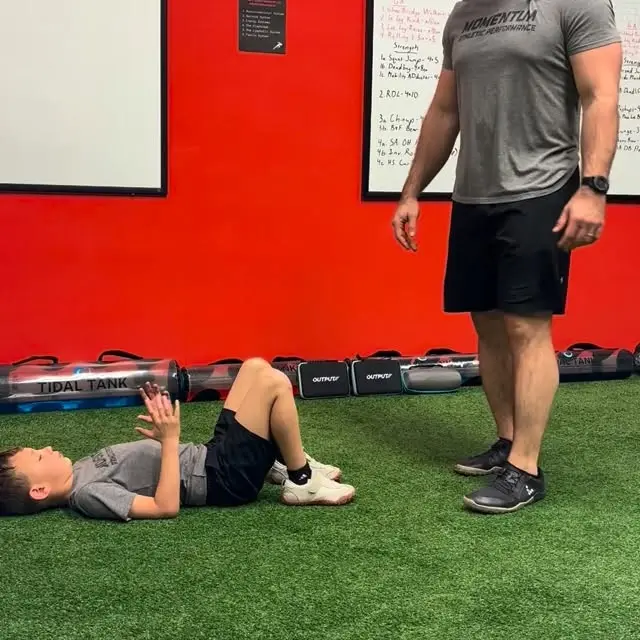
Every athlete at Momentum earns intensity the same way: demonstrate the movement first. Our youngest group, Jump Start for ages 7 to 11, is built entirely around this idea: kids learn to sprint, jump, land, stop and carry with sound mechanics before load or intensity ever enters the conversation. Here is what that safety system looks like across all our groups:
- Small groups, so no athlete trains unwatched
- CSCS and Parisi-certified coaches leading every session. meet them here
- Technique-first progression: movements are earned, never assumed
- Age-based groups, so a 9-year-old is never training like a 16-year-old
- Measured loading for older athletes: velocity-based training adjusts weight to how the athlete actually shows up that day
Coach's Tip
Evaluating any youth training facility? Ask three questions: What are your coaches certified in? How many athletes per coach in a typical session? And how does an athlete earn the right to add weight to a lift? Confident, specific answers to all three are the mark of a program that takes safety seriously.
Age-appropriate means something different at every age
Safe training for a 8-year-old, a 12-year-old and a 16-year-old are three different things. Elementary athletes need games, coordination and movement skill: training that feels like play with coaching hidden inside. Middle schoolers are ready for structured speed sessions and technique-first strength work with light loads. High school athletes can train with real intensity, because the years of movement quality underneath them make that intensity productive instead of risky. Our training groups are split by age and stage for exactly this reason.
Confidence is a safety outcome too
There is a quieter benefit that parents notice after a few months: kids who are taught to move well trust their bodies. They stop, cut and land with control instead of chaos. They carry themselves differently on the field, and off it. Building durable, confident movers is the entire point of youth athletic development done right.
Still have questions about group sizes, ages or how a first visit works? Our FAQ page covers the details, and the schedule shows when each group trains. Better yet, come watch a session with your own eyes. The first class is free.