
Ask any high school or college coach what they wish they could give every athlete, and you will hear the same answer: speed. What most parents never hear is the second half of that conversation: speed can absolutely be developed. It just has to be developed at the right time, in the right way. And for the majority of athletes, the right time is middle school.
At Momentum Athletic Performance in Canal Winchester, we build our middle school programming around this window on purpose. Here is why ages 11 to 14 matter so much, and how parents can make the most of them.
What makes ages 11 to 14 different
During the middle school years, young athletes are going through a stretch of rapid physical and coordination change. Their bodies are growing, their nervous systems are highly adaptable, and the movement patterns they practice now are the ones that become automatic later. Coaches and sport scientists often describe these years as a prime window for developing coordination, movement quality and speed. The habits an athlete builds here tend to stick for their entire career.
That cuts both ways. A 12-year-old who learns clean sprint mechanics carries them into high school. A 12-year-old who spends three more years running with poor arm action and short, choppy strides carries that too, and it is much harder to fix at 16 than it is to teach correctly at 12.
Speed is a skill, not a gift
Sprinting is a technical skill, the same way a jump shot or a golf swing is a technical skill. It has learnable components:
- Arm action that drives rhythm instead of fighting it
- Knee drive and front-side mechanics
- Shin angles that produce force in the right direction
- Ground contact under the hips instead of out in front
None of those come pre-installed. They are coached, practiced and refined, and middle schoolers are at the perfect age to absorb them. They are old enough to follow structured coaching and young enough that bad habits have not hardened into permanent movement patterns.
What smart speed training looks like at this age
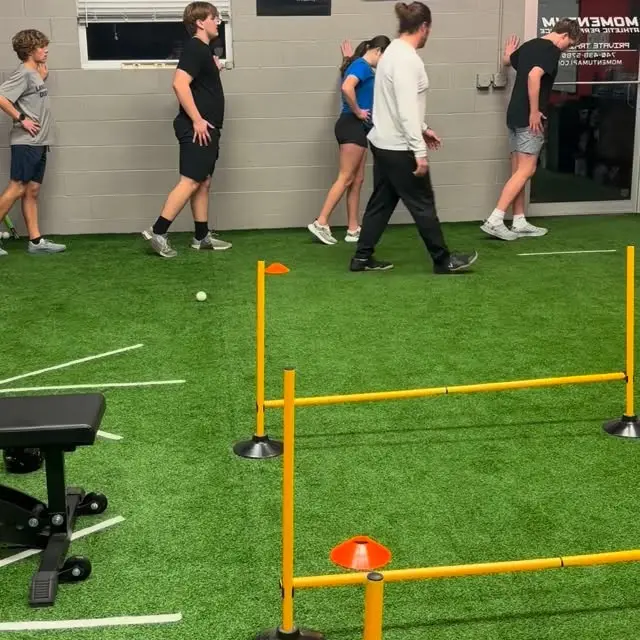
In our Total Performance group for middle schoolers, speed is trained in focused sessions built around acceleration mechanics, top-end speed and change of direction. Groups stay small, so a coach is watching every rep, not scanning a crowd of thirty kids and hoping for the best.
Just as important: we measure. Every athlete sprints through DASHR electronic timing gates, so progress is objective instead of guesswork. When a 12-year-old sees their 10-yard split drop over eight weeks, two things happen. The parent knows the training is working, and the athlete starts believing they can get faster. That belief changes how hard they work at everything.
Coach's Tip
Film your athlete sprinting from the side at their next practice. If their foot lands well out in front of their hips, they are braking on every stride. That is one of the most common and most fixable speed leaks in middle school athletes. It is exactly the kind of thing a certified coach corrects in the first few sessions.
Do not forget strength: the other half of the window
Speed is force applied to the ground quickly, which means strength matters too. Middle school is an excellent time to learn lifting technique with light loads and strict standards, so that by high school the athlete is ready to train with real intent. Our CSCS and Parisi-certified coaches teach technique first, always. No athlete adds weight to a movement they have not earned.
How parents can get started
- Look for small groups, certified coaches and objective measurement, not just cones and whistles
- Check our class schedule to find a session that fits your week
- Have questions about age or readiness? Our FAQ page covers the most common ones
- Let your athlete try it. The first class is free, so there is nothing to lose
The middle school window does not stay open forever. Athletes who use it enter high school ahead: faster, more coordinated and more confident than the teammates who waited.